



















Filter by governorate, bedrooms and budget — direct-to-developer pricing in OMR.
All properties →Search by name, filter by project count, and read full developer profiles.
All developers →Find the right area by budget, lifestyle and expected rental yield.
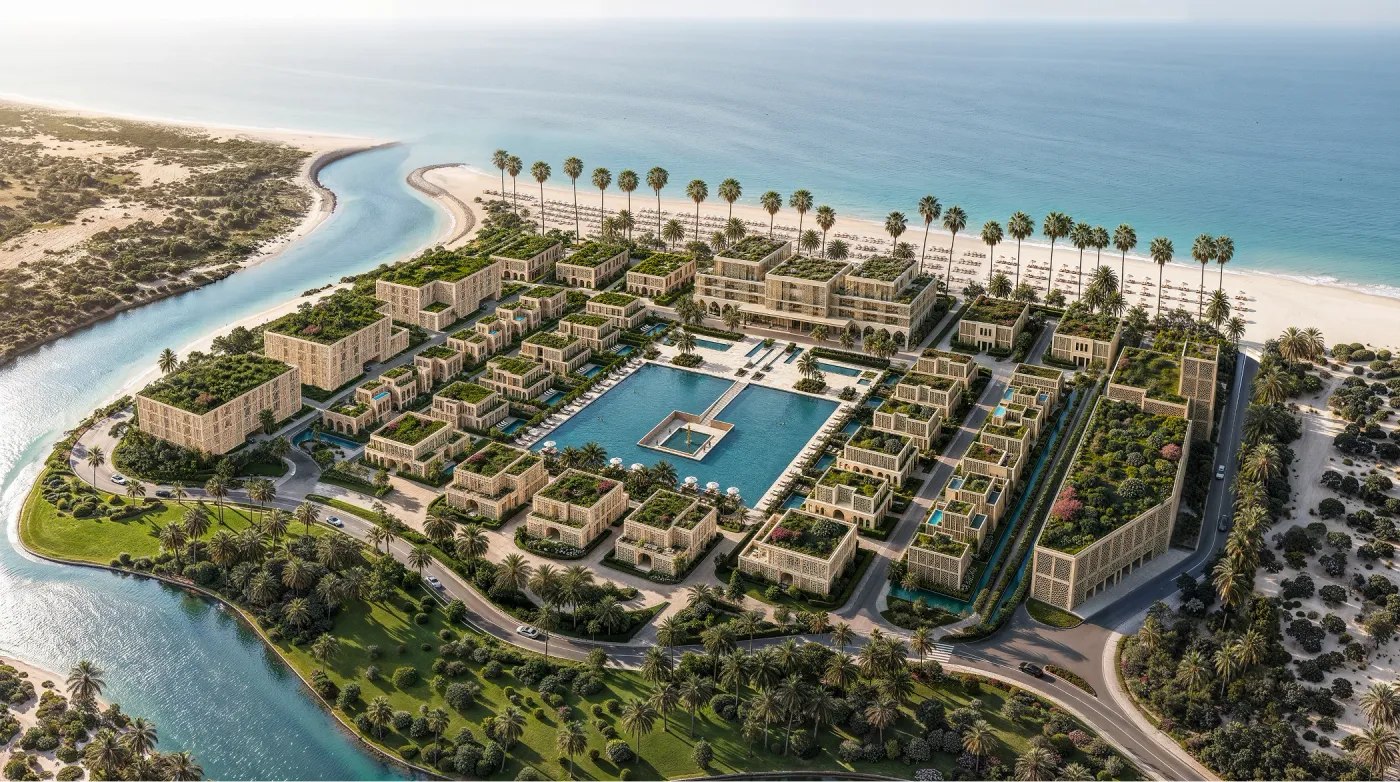
All areas →Dhofar is Oman's southern governorate, a 1.5-hour flight from Muscat, with the coastal city of Salalah at its heart. For roughly sixty days each summer the Khareef monsoon drapes the mountains in cloud and turns the whole region emerald green — a micro-climate found nowhere else in Arabia that drew over one million visitors in 2025, the bulk of them from Oman and the wider GCC. Beyond the season, Dhofar offers white-sand beaches, the UNESCO-listed Land of Frankincense, and one of the world's busiest transshipment ports. For foreign buyers the gateway is Hawana Salalah, the Muriya-developed beachfront Integrated Tourism Complex where 100% freehold ownership, 0% annual property tax and Oman residency come bundled with a marina, multiple hotels and an aqua park.
Dhofar is reached primarily by air; within the governorate, the Salalah–Thumrait highway (N31) links the coast to the interior and the inland frankincense sites, while the coastal road threads Salalah to Al Mughsail and the eastern fishing towns of Taqah and Mirbat.
Dhofar's investment story is built on <b>seasonal tourism rather than year-round office demand</b>. The flagship freehold address is <b>Hawana Salalah</b>, the Muriya (Orascom × Omran) Integrated Tourism Complex on the beachfront, where foreigners can own 100% freehold. Published entry pricing for the current <b>Amazi</b> release starts from around <b>OMR 115,000</b> on a 36-month developer payment plan, and Muriya markets furnished hotel-managed apartments at indicative annual returns of roughly <b>5–6%</b>. The demand driver is the <b>Khareef monsoon</b>: more than one million visitors arrived in the 2025 season (Jun–Aug), concentrating short-let occupancy into a few high-intensity months. <b>Oman levies 0% property tax and 0% personal income tax</b>, and an ITC purchase carries Oman residency — so net carry on a holiday-let here is unusually light. Precise per-square-metre price indices and year-on-year trend data are not published for Salalah at the granularity available in larger Gulf markets; figures above are developer-stated and should be confirmed for the specific unit and release.
Live from the catalog — sorted cheapest first.
Yes — within a designated Integrated Tourism Complex (ITC). In Dhofar the main freehold gateway is Hawana Salalah, the Muriya-developed beachfront destination, where foreign nationals of any nationality can own apartments, chalets and villas on a 100% perpetual freehold basis with full rights to live in, rent out, sell or bequeath the property. Ownership outside the ITC zones is restricted, so the practical route for an overseas investor in Salalah is to buy inside Hawana Salalah.
The Khareef is Salalah's summer monsoon, a roughly sixty-day micro-climate (around June to September) that wraps the Dhofar mountains in mist and turns the region green while the rest of the Gulf bakes. It is unique in Arabia and draws huge GCC tourism: the 2025 season recorded over one million visitors across the governorate. For property owners this means short-let demand spikes sharply in the Khareef months, so a Salalah holiday-home is best modelled around seasonal occupancy rather than steady year-round letting.
Muriya markets furnished, hotel-managed apartments at indicative annual returns of around 5–6% in Hawana Salalah. Returns in Dhofar are driven by the Khareef season, when occupancy and nightly rates climb sharply, so a short-let model concentrated on those months can perform differently from a flat long-let yield. Because granular, independent rental indices for Salalah are limited, treat developer-stated figures as a starting point and confirm the projected return — in writing, in the sales agreement — for the specific unit and management programme.
Entry on the current Amazi release starts from around OMR 115,000 (developer-published), typically on a 36-month payment plan — a deposit followed by interest-free quarterly instalments through to handover. Pricing varies by unit type, floor and view; chalets, marina apartments and villas span a wider range. A separate 5% VAT applies on off-plan units and a 3% registration fee is paid at title-deed issuance. Always confirm the current price list with the developer, as releases and availability change.
Yes. Buying freehold inside an ITC such as Hawana Salalah grants Oman residency — the developer markets a 2-year renewable property-linked permit, and a purchase of OMR 200,000 or more (single property or aggregated) qualifies for the 10-year Golden Residency. The Golden Residency covers the investor's spouse and first-degree relatives, allows a 100% foreign-owned company, and lets the owner lease the property without taxation. Applications are filed through the Royal Oman Police e-visa portal once the purchase thresholds are met.
Oman is one of the most tax-light markets in the Gulf. There is 0% annual property tax, 0% personal income tax, 0% capital gains tax on a property sale, and 0% inheritance tax. Rental income is untaxed for owners, including Golden Residency holders. At purchase you pay a 3% registration fee and 5% VAT on off-plan residential units. Combined with low service charges, this makes the ongoing cost of holding a Salalah holiday-home notably lighter than comparable UAE assets.
Through a mandatory escrow account. Omani law requires all buyer payments on a licensed off-plan project to be held in escrow at an approved Omani bank and released to the developer only as construction milestones are certified — the single most important consumer protection in the market. Before signing, check that the project carries a Ministry sales licence and that the escrow bank, branch and account number are written into the sales agreement. If a seller asks you to pay directly into a developer's operating account instead of escrow, that is a red flag.
Salalah is served by its own international airport (SLL), about 5.5 km from the city and roughly 20 minutes from Hawana Salalah. The current terminal opened in 2015 and is built to scale from one million up to six million passengers a year. As of mid-2026 around 14 airlines fly to roughly 17 destinations — Muscat is the dominant route (a 1.5-hour hop), with Dubai, Sharjah and Doha the key international links and additional seasonal carriers added for the Khareef. Dhofar is also home to the Port of Salalah, one of the world's leading container transshipment hubs, anchoring the region's logistics economy.
Signed-in users see all their conversations on any device — site and investor portal.
Ask me about Dhofar