



















Home / Areas / Muscat/ Sultan Haitham City
Oman's flagship sustainable smart city — a new Muscat district in the making.

Sultan Haitham City

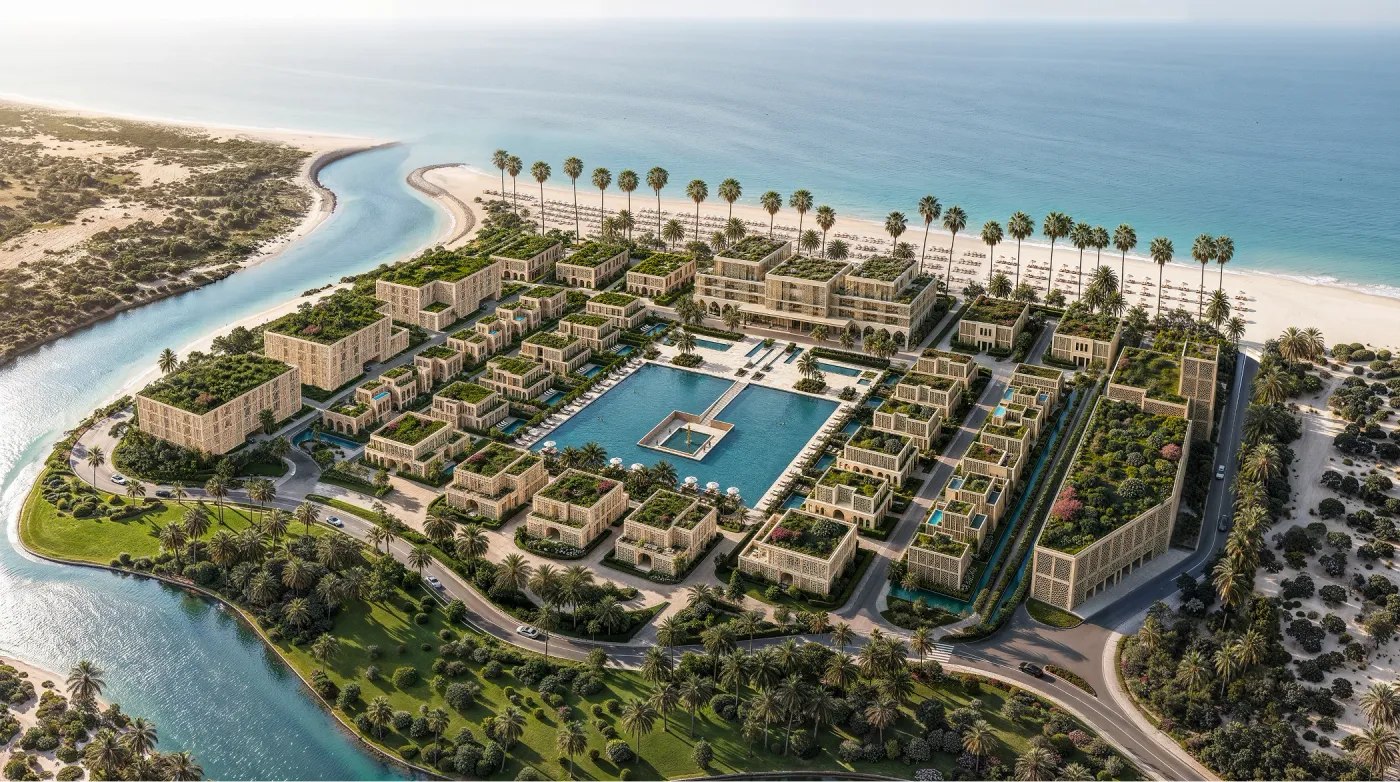
Sultan Haitham City is Oman's most ambitious new-city project — a 14.8 sq km master-planned smart city in Wilayat Al Seeb, west of Muscat, designed by global architects SOM for around 20,000 homes and 100,000 residents across nineteen neighbourhoods. Commissioned by the Ministry of Housing & Urban Planning as a cornerstone of Oman Vision 2040, it is built around a reinvented 7.5km wadi park, walkable green districts, solar power, smart mobility and integrated public transport. Within it, Hay Al Wafaa by Al Abrar Real Estate is a one-million-sqm freehold-eligible community of apartments, townhouses and villas — its first phase targeting completion in 2026. For foreign buyers it pairs a government-backed megaproject with 0% property tax and a path to Oman's Golden Residency.

Hay Al Wafaa · Al Ahlam · Al Sarooj Oasis · Hai Al Nuha · Jood · Wadi Zaha (19 neighbourhoods planned) Government-led new city · Sustainable smart city · Mixed-use master community
~20,000
Planned homes
3
Projects on Palmera
CONNECTIVITY

Where Sultan Haitham City sits.

Seamless access to the Muscat Expressway and Al Batinah Highway, with Seeb Street linking the city into greater Muscat — placing the airport, Mall of Muscat and the Seeb coast all within a short drive.

Drive times

Muscat International Airport~30 min
Mall of Muscat~13 min
Seeb Beach~12 min
German University of Technology (GUtech)~15 min

Metro & transport

Public transit + walking & cycling routes · Planned
Nearest station today: Internal smart-mobility & public-transport network
<b>Sultan Haitham City is designed around sustainable mobility rather than a metro.</b> The SOM masterplan dedicates routes to public transport, smart mobility, walking and cycling, anchored by a 7.5km reinvented wadi that runs as a green spine through the city. Air-quality monitors, smart public lighting and advanced traffic management are built into the plan — the intent is that everyday trips happen on foot, by bike or by transit rather than by car.

Major roads

Muscat Expressway
Al Batinah Highway
NEIGHBORHOOD LIFE

A full life — without leaving.

Education

  • School complex inside Hay Al Wafaa
  • Kindergartens within the community
  • German University of Technology (GUtech) — ~15 min

Healthcare

  • International hospital & healthcare centre in Hay Al Wafaa
  • Badr Al Samaa Hospital — ~6 min

Shopping

  • Mall of Muscat (~13 min)
  • Retail-lined ground floors within Hay Al Wafaa
  • Neighbourhood shopping gallery

Leisure

  • 7.5km wadi central park & green spine
  • Walkable green neighbourhoods
  • Dedicated cycling routes
  • Children's play areas & sports facilities
  • Social event halls
  • Seeb Beach (~12 min)

Landmarks

  • Sultan Haitham City masterplan (SOM)
  • Hay Al Wafaa community
  • Two on-site mosques & Majlis
  • 2.9 million sqm of planned public space
THE DATA

The numbers. No fluff.

Sultan Haitham City is an <b>early-stage, government-led new city</b> rather than an established rental market, so granular yield and per-sqm resale benchmarks are not yet meaningful. What is documented is the scale and momentum: the masterplan targets around <b>20,000 homes for 100,000 residents</b>, delivered at roughly <b>1,000 units a year</b>, with infrastructure investment across Phases 1 and 2 of about <b>RO 300 million</b> and roughly <b>1,700 units already sold to buyers from more than 35 nationalities</b> (Oman Observer, Feb 2026). Inside the city, <b>Hay Al Wafaa</b> by Al Abrar Real Estate is a one-million-sqm community of about <b>1,800 homes</b>, with a first phase of <b>375 units</b> targeting completion in 2026; published starting prices begin around <b>OMR 27,800</b> for apartments and <b>OMR 65,000</b> for three-bedroom villas/townhouses (Times of Oman). As an Oman freehold-eligible district, ownership carries <b>0% annual property tax, 0% capital-gains tax and 0% inheritance tax</b>, and a qualifying purchase opens the path to Golden Residency.

0
FIGURES INDICATIVE, NOT A GUARANTEE · AS OF 2026-06-08
IS IT RIGHT FOR YOU?

Who Sultan Haitham City suits best.

A strong fit if you're…
  • Early-entry investors who want ground-floor pricing in a government-backed Vision 2040 megaproject before the city matures
  • End-users and families wanting a walkable, green, full-amenity neighbourhood (schools, hospital, mosques, parks) on Muscat's western edge
  • Foreign buyers seeking a freehold-eligible Oman home with 0% property tax and a route to Golden Residency
Look elsewhere if you want…
  • Investors who need immediate rental income or proven resale liquidity should note this is an off-plan launch phase — the rental and secondary market is still forming
3 PROJECTS IN SULTAN HAITHAM CITY

What's available right now.

Live from the catalog — sorted cheapest first.

GOOD TO KNOW

Common questions about Sultan Haitham City.

What is Sultan Haitham City?+

Sultan Haitham City is Oman's flagship new sustainable smart city — a 14.8 sq km (1,500-hectare) master-planned development in Wilayat Al Seeb, west of Muscat, commissioned by the Ministry of Housing & Urban Planning and designed by global architects SOM. It is planned for around 20,000 homes and 100,000 residents across nineteen neighbourhoods, organised around a reinvented 7.5km wadi park, walkable green districts, solar power, smart mobility and integrated residential, commercial and cultural zones. It is a cornerstone of Oman Vision 2040, with phased delivery running through the late 2020s and beyond.

Can foreigners buy property in Sultan Haitham City?+

Yes — within designated freehold-eligible districts. Oman's expanded foreign-ownership framework under Vision 2040 (Royal Decree 38/2025) opened freehold ownership to buyers of all nationalities in approved zones, and Sultan Haitham City includes residential districts open to foreign buyers. The headline example is Hay Al Wafaa by Al Abrar Real Estate, which is marketed as a freehold-eligible community for all nationalities. As always in Oman, freehold eligibility is district- and project-specific, so confirm the exact ownership status of the individual building or villa before you buy.

What is Hay Al Wafaa and who develops it?+

Hay Al Wafaa is one of the headline residential neighbourhoods inside Sultan Haitham City, master-developed by Al Abrar Real Estate. It spans roughly one million sqm and is planned for around 1,800 homes — a mix of apartments, townhouses and villas — wrapped around landscaped courtyards, retail-lined ground floors and shaded community walkways. Inside its footprint sit two mosques and a Majlis, a school complex, kindergartens, an international hospital, children's play areas and social event halls, all connected into Sultan Haitham City's wider green corridors and cycling routes.

How much do homes in Hay Al Wafaa cost, and when do they complete?+

Published starting prices begin around OMR 27,800 for apartments and OMR 65,000 for three-bedroom villas/townhouses (Times of Oman). The first phase comprises about 375 units and is targeted for completion in 2026, with the surrounding roads, utilities and lighting finalised alongside the homes. Because this is an off-plan launch, available unit types, exact pricing and payment plans move with each release — Palmera can confirm current availability directly with Al Abrar Real Estate.

What taxes and residency benefits come with buying here?+

Oman levies 0% annual property tax, 0% personal income tax, 0% capital-gains tax and 0% inheritance tax, so rental income and any future resale gain are not taxed at the individual level. On a freehold purchase, foreign owners also gain inheritance rights to first-degree relatives. A qualifying real-estate investment of OMR 200,000 or more opens the path to Oman's Golden Residency — a 10-year renewable visa covering the investor and immediate family. One-time costs to budget for include 5% VAT on new-build instalments, a 3% title-deed registration fee on handover and modest notary fees.

How is an off-plan purchase protected, and what is the scale of the wider city?+

Off-plan buyers in Oman are protected by the regulated escrow framework — developer collections are channelled through a project escrow account and released against construction milestones, so funds are tied to delivery progress. On the city's scale and momentum: infrastructure investment across Phases 1 and 2 is about RO 300 million, roughly 1,700 units have already been sold to buyers from more than 35 nationalities, eight developers are active inside the city, and part of the first phase is expected to open during 2026 (Oman Observer, Feb 2026). That combination of government backing, multiple developers and early sales is the core of the investment case while the rental market matures.

YOU MIGHT ALSO LIKE

Similar areas.

Chat with Jamila