



















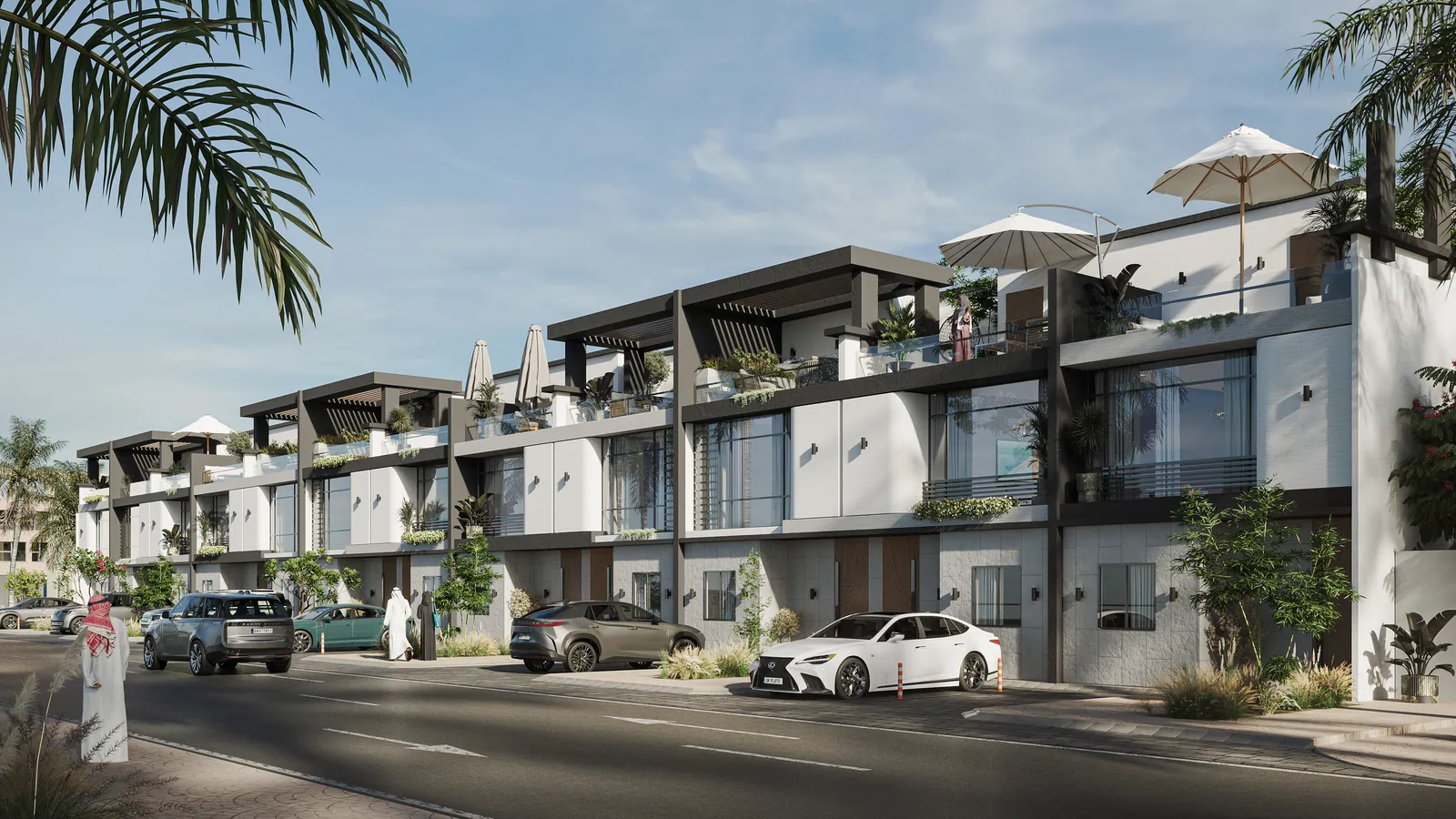


Riyadh’s Nine Foreign-Ownership Zones: Where a Non-Saudi Can Actually Buy


Most buyers arrive asking whether a non-Saudi is allowed to own property in Saudi Arabia. Since 22 January 2026 the answer has been yes. The question that decides whether a purchase works is where, and that answer is far narrower than the headlines suggested.
Foreign ownership in Riyadh is not city-wide. It is permitted inside nine approved zones, set out in the Geographic Zones Document the Council of Ministers published on 23 June 2026. Outside those boundaries a non-Saudi still cannot own.
Eight of the nine are state-backed giga-projects, most still under construction. The zone map is therefore a map of construction programmes, not of neighbourhoods, and that changes what you are buying: not a district with a rental history and independent sellers, but one developer’s delivery schedule, with no resale record to check it against.
What the nine-zone map is, and what it is not
The Law of Real Estate Ownership by Non-Saudis came into force on 22 January 2026, and REGA opened the “Saudi Properties” platform, where eligibility is verified and the application is submitted (source: REGA). What decides your case is the boundary on the map, not the name on the brochure. A project sold as “beside King Salman Park” is not a property inside the zone.
The map is provisional. REGA calls the current list a starting point rather than a final document and gives no timetable for adding zones (source: Enterprise KSA). Plan around the nine you can see, not a tenth. Penalties reach SAR 10 million, and a property acquired on false information can be sold at public auction (source: White & Case).
| Zone | What it is | Where it stands | Who it suits |
|---|---|---|---|
| KAFD | Financial district, 1.6 sq km | Operating, on the metro, still building out | A buyer who wants a working address, not a promise |
| Diriyah Gate | 14 sq km heritage district around At-Turaif | Under construction, residential in phases | Trophy buyer, long hold |
| New Murabba | 19 sq km downtown around the Mukaab | Landmark suspended, horizon towards 2040 | High risk tolerance only |
| King Salman Park | 16 sq km park, 12,000 planned homes | In construction on the old airbase | Amenity-led, patient capital |
| Qiddiya | Roughly 360 sq km entertainment city | First venues open, wider city years away | A believer in the entertainment thesis |
| King Salman International Airport | 57 sq km, 12 sq km of non-airport uses | In construction, airport targeted for 2030 | Hospitality and logistics, not lifestyle |
| SEDRA | 20 sq km suburb, around 30,000 homes | Occupied since 2022, phases handing over | Closest to a normal home purchase |
| Sports Boulevard | 135 km linear park across the city | First 83 km open since February 2025 | Frontage on a new public amenity |
| TOD sites | Areas around metro stations | Framework live, plots vary widely | The most conventional urban address |
KAFD: the only zone that already operates
The King Abdullah Financial District is the exception, because enough of it is built to judge. The site covers about 1.6 sq km off King Fahad Road, with over 900,000 sq m of offices and more than 5,000 homes planned; as of 2023 it was roughly 40 per cent complete, with about 95 finished buildings and some 12,500 residents, so treat that completion share as dated (source: Arab Urban Development Institute). Tadawul Tower, the Saudi Exchange headquarters, completed at the end of 2022 (source: CTBUH), and the district has its own metro station, open to passengers since the first Riyadh Metro lines began service on 1 December 2024 (source: Saudi Press Agency). Here you are underwriting the asset, not the existence of the district. Returns come from occupancy and rent.
Diriyah Gate: scarcity built on heritage
Diriyah is a 14 sq km development wrapped around At-Turaif, the mud-brick citadel district UNESCO inscribed in 2010 as the first capital of the Saudi state and a leading example of Najdi architecture (source: UNESCO). The masterplan mixes heritage, hospitality, retail, cultural and residential districts in one Najdi vocabulary, with 40 hotels and more than 566,000 sq m of retail planned, and Diriyah Square as its walkable centre (source: Diriyah Company).
The bull case is scarcity: one UNESCO site next to Riyadh, a fixed amount of land beside it. The bear case is that heritage-led luxury is the most fashion-sensitive part of any market, and Diriyah has no resale benchmark yet, so honest price discovery only begins after handover. Buy it as a trophy on a long hold, and price it that way.
New Murabba and King Salman Park: the downtown bets
New Murabba is a planned downtown at the intersection of King Salman and King Khalid roads: 19 sq km, more than 104,000 homes and 9,000 hotel rooms at full build, with the 400 m Mukaab cube at its centre (source: PIF).
This is where a broker owes you the uncomfortable version. In January 2026 Reuters reported that work on the Mukaab beyond excavation and piling had been suspended while PIF reassessed spending, and that the district’s completion horizon had moved from 2030 towards 2040, though the surrounding real estate is expected to continue. PIF and the project did not comment (source: Gulf Business, Middle East Eye). You would be buying a district that is being redrawn while you sign. At the right entry price that can still be rational, but it is not conservative, and anyone selling it to you as a settled 2030 story is not reading the news.
King Salman Park is the calmer of the two: more than 16 sq km on the old Riyadh airbase, around 11 sq km of it green, with residential compounds of roughly 12,000 homes, 16 hotels and the Royal Arts Complex in the masterplan (source: Royal Commission for Riyadh City). The case is amenity, inside a city that already exists. Delivery risk is real, but the demand around it is not hypothetical.
Qiddiya, Sports Boulevard and the airport: property as a by-product
Three zones were never conceived as places to live, and you should underwrite them that way. Qiddiya covers roughly 360 sq km in the Tuwaiq mountains outside Riyadh. Six Flags Qiddiya City opened on 31 December 2025 (source: Saudi Press Agency) and Prince Mohammed bin Salman Stadium is planned as a 2034 World Cup venue (source: Qiddiya). Residential value there depends on people going routinely, not only for events.
The Sports Boulevard is a 135 km linear park along Prince Mohammed bin Salman Road, linking Wadi Hanifah in the west of the city to Wadi Al Sulai in the east, with more than 220 km of cycling paths; its first phase, 83 km of the route, opened in February 2025 (source: Royal Commission for Riyadh City, ASCE). It runs through the built city, so you buy frontage on a public amenity, not a seat in a new town.
King Salman International Airport spans 57 sq km with six runways, targeting up to 120 million passengers a year by 2030, with roughly 12 sq km reserved for residential, retail and logistics uses (source: Airport Technology, KSIA). That is an aerotropolis case: serviced hospitality, staff accommodation, logistics. Judge it on operating demand, never on the view.
SEDRA and the TOD sites: the two that behave like housing
SEDRA is a 20 sq km master-planned community in north Riyadh, planned at around 30,000 homes across eight phases, with residents in place since 2022 (source: ROSHN, Saudipedia). Of the nine, this is the closest thing to an ordinary residential purchase. There is a handover record to inspect instead of a render.
The ninth entry is transit-oriented development along the metro. The Royal Commission treats land within 800 m of a station as a TOD area with its own rules and incentives, aimed at high-density mixed use (source: RCRC). With the Sports Boulevard, it is the part of the map inside the existing city rather than beside it, and the part where checking the exact property matters most. A station’s planning radius and an ownership zone boundary need not be the same shape.
What this map does to your risk
Concentration comes first. In a normal market, if your building underperforms, the district still puts a floor under it. In most of these zones the building and the district share one owner and one capital programme, and when that owner reprioritises, as PIF did with the Mukaab, there is nothing independent to fall back on. Liquidity comes second. Your future buyer also has to be allowed to own inside the zone, which makes the zone list your exit list.
Then the gap we will not paper over. There is no reliable public series for Riyadh rental yields, price per square metre or price growth that we would put our name to. Anyone quoting you a precise Riyadh yield today is presenting an estimate as data.
The costs and paperwork are identical in all nine
Real Estate Transaction Tax is 5 per cent of transaction value, administered by ZATCA, replacing the 15 per cent VAT that used to apply to these sales (source: ZATCA). The seller is primarily liable to remit it, so if a contract shifts that cost onto you, it has to say so in writing. VAT at 15 per cent still applies to brokerage, legal work and valuation. Closing costs usually land between 6 and 9 per cent where the buyer carries the main items. Palmera charges the buyer nothing, because the developer pays the commission.
Under the Real Estate Brokerage Law the brokerage contract must be written and a copy deposited with REGA, and one that is not deposited is unenforceable; commission defaults to 2.5 per cent unless agreed otherwise in writing (source: REGA). Off-plan sales run through the Wafi programme, and the escrow rules block withdrawals while identified construction or finishing defects are outstanding. Buying land rather than a built unit adds white land tax, 2.5 to 10 per cent of assessed value a year by tier (source: CMS).
What to check before you sign
Have the exact property checked against the zone map through the Saudi Properties portal, and keep the result. “The project is in an approved zone” is a marketing sentence, not a legal one. Get written confirmation that the unit is eligible for non-Saudi ownership and that resale to a non-Saudi buyer is permitted, with the service charge schedule and any exit fees. If you are not resident in the Kingdom, start the digital identity step through a Saudi embassy early, or register through Invest Saudi for the Unified Number (700) if you are buying through a company. That paperwork, not the purchase, sets the timetable.
One thing we will not tell you: that buying in one of these nine zones gives you a residency permit. Long-stay programmes exist and are being reshaped under Vision 2030, but the link to a property purchase is not something we can confirm as a general rule, so we confirm it per case, in writing, before anyone signs. Send us the plot or unit reference and the first thing you get back is which of the nine zones it sits in, or that it sits in none of them.